
May 23, 2026
Your Expert Guide to Cool Peel Recovery Day by Day
Navigate your cool peel recovery day by day with our 2026 expert guide. Discover what to expect, aftercare tips, & when to apply makeup for a smooth healing
May 23, 2026
You've just looked in the mirror after your CoolPeel treatment. Your skin feels warm, looks pink to red, and you're wondering whether this is normal, how long it will last, and when you'll feel comfortable being seen again. Those are the right questions.
CoolPeel recovery is usually straightforward, but it goes better when you know what's expected on each day and what your skin needs at each stage. I tell patients to think of recovery as a short sequence of distinct phases, not one continuous blur. If you understand the pattern, you're much less likely to over-treat your skin, pick at it, or return to normal routines too quickly.
The first thing most patients notice is heat. The second is color. Right after treatment, the skin usually has a sunburn-like warmth and visible redness, which can be unsettling if you weren't expecting it. In most cases, that early look is exactly what I want to see.
Patients often hear that CoolPeel has “low downtime” and assume they'll look completely normal the next morning. That's not how I frame it. A better term is social downtime.
You're usually not dealing with the prolonged recovery typical of more aggressive fractional CO2 resurfacing, but you are still healing. That means your skin will pass through recognizable steps. According to day-by-day CoolPeel recovery guidance, recovery is typically staged rather than linear: immediate redness and warmth are followed by a rough or dry interval, then visible peeling or sloughing, with the first week serving as the main downtime window.
Practical rule: If your skin feels hot and looks flushed on treatment day, that's usually normal. The mistake is treating it like ordinary dry skin and starting too many products too soon.
In a typical Cool peel recovery day by day course, the mirror changes before the final result does. Early healing is about barrier recovery. The polished look comes later.
What works is simple, patient aftercare:
If you want background on how the treatment works before recovery begins, our overview of the CoolPeel laser is a useful starting point.
The first three days are when patients either make recovery easier or accidentally prolong irritation. Most problems I see after laser treatments are not from the treatment itself. They come from over-cleansing, under-moisturizing, early sun exposure, or trying to “help” peeling skin along.
Early recovery is easiest when you treat the skin as temporarily fragile and resist the urge to make it feel squeaky clean.
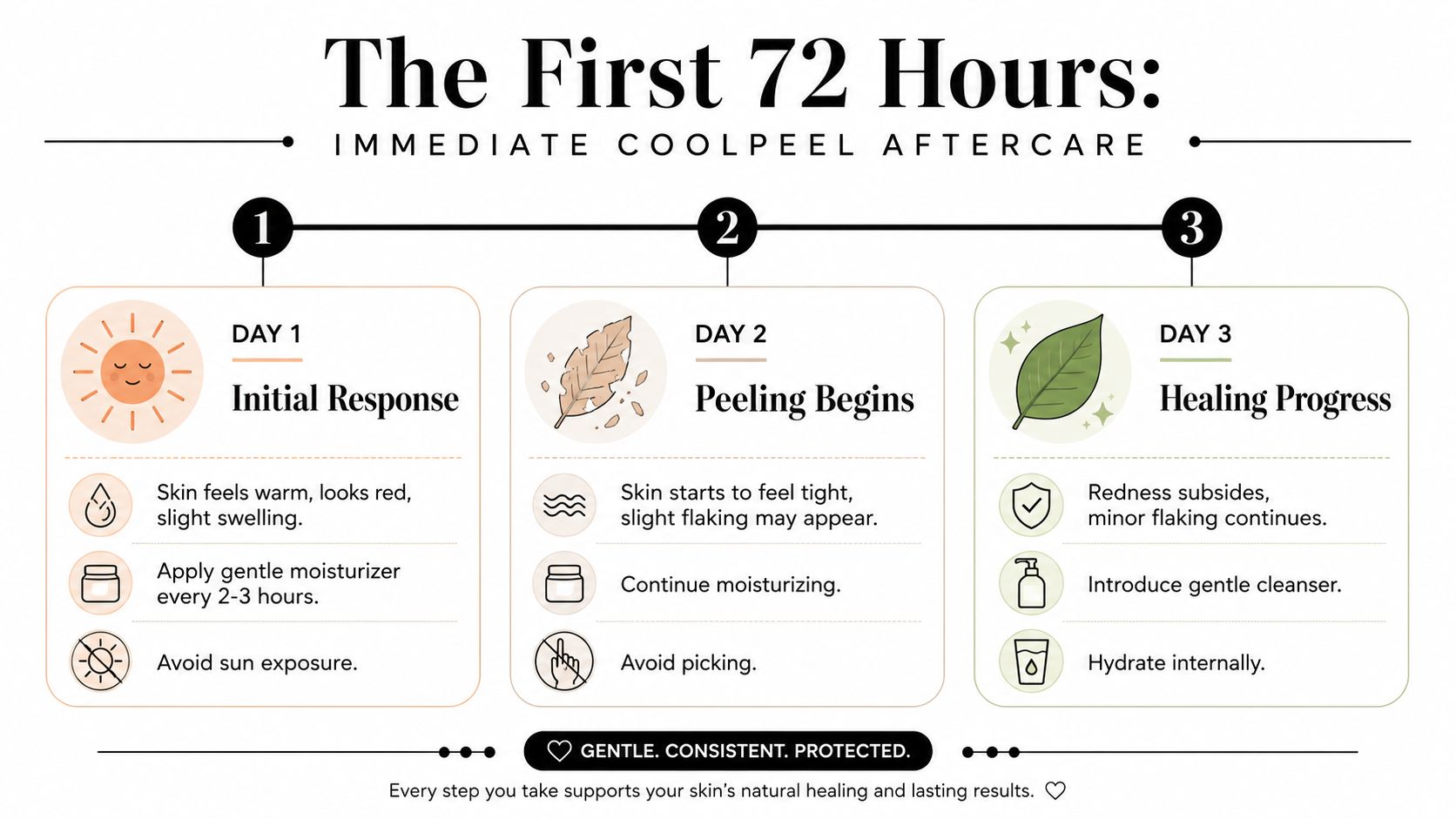
When you leave the office, the skin usually feels warm and looks flushed. Some patients describe it as a fresh windburn. Others say it feels like they've been in the sun too long.
Your job that evening is straightforward:
The first night should be quiet. No workout, no sauna, no experimenting with products.
Day 1 is often the day patients notice the most visible redness. Clinic guidance notes that Day 1 commonly brings redness and a sunburn-like feeling, with a practical return-to-activities window of about 2 to 3 days for light social downtime according to this day-by-day CO2 recovery guide.
That doesn't mean everyone wants to be in public on Day 2. It means many patients can work from home right away and resume lighter in-person routines once the redness settles to a level they're comfortable with.
Most patients do best when they stop looking for progress every hour. Day 1 often looks more dramatic than Day 3.
A good Day 1 routine usually includes:
For patients comparing recoveries, our erbium laser day-by-day recovery guide helps clarify why different resurfacing treatments heal on different schedules.
A short overview can also help if you're a visual learner:
This is the stage that catches people off guard. The skin may stop looking intensely red, but it starts to feel rough, dry, or sandy. That texture usually means the treated microscopic skin is beginning to shed.
What works here is restraint:
What doesn't work is trying to force the process. Patients who rub off flaking skin almost always make the redness last longer.
By this point, many patients feel better than they look. The heat has usually settled, but the skin can appear patchy, a little dull, or visibly flaky. That's expected. This is the turnover phase.
The rough texture often transitions into light peeling or sloughing. This may be more noticeable around the mouth, chin, and cheeks. Some patients describe it as dry flakes. Others notice a fine, grainy shedding pattern.
The rule here is simple. Don't pick, peel, scrub, or exfoliate. If skin is lifting, let it release on its own while you keep the area moisturized.
A common mistake is trying to speed things up because an event is coming. That usually backfires. Makeup can cling to loose skin, and exfoliating can leave the skin more inflamed than before.
As the loose surface clears, the skin usually starts to look smoother and brighter. That's when patients feel the treatment “worked,” even though the biologic improvement continues after the visible peeling ends.
Some residual pinkness can still linger, and that doesn't mean anything is wrong. In practice, I tell patients that the first week is the visible healing week. The skin may still need a gentler routine into the following week.
New skin is easy to overestimate. It may look fresh, but it's still more reactive than your usual baseline.
If you're prone to clogged pores while using heavier moisturizers, our discussion of a breakout after a chemical peel can help you distinguish normal congestion from irritation-driven overcare.
| Day(s) | What to Expect (Sensation & Appearance) | Primary Aftercare Focus |
|---|---|---|
| Treatment day | Warmth, redness, possible mild swelling | Cooling, bland moisturizer, no heat or friction |
| Day 1 | Most noticeable redness, sunburn-like feeling | Gentle cleansing, frequent moisture, rest for the skin |
| Days 2 to 3 | Tightness, dryness, rough or sandy feel | Hydration, hands off, no exfoliation |
| Days 4 to 5 | Peeling or sloughing becomes more visible | Let skin shed naturally, continue gentle care |
| Days 6 to 7 | Smoother skin starts to show, some pinkness may remain | Barrier support, gradual return to routine only if skin is calm |
By week two, the dramatic part of recovery is usually behind you. Some patients still have a pink undertone, especially in areas that were more reactive. That's not the point to declare your skin fully back to normal.
It's the point to stay disciplined. Gentle care still wins.
Patients usually run into trouble here for a simple reason. They add too much, too soon. After CoolPeel, the skin barrier is temporarily weaker, so the safest routine is short, bland, and consistent.
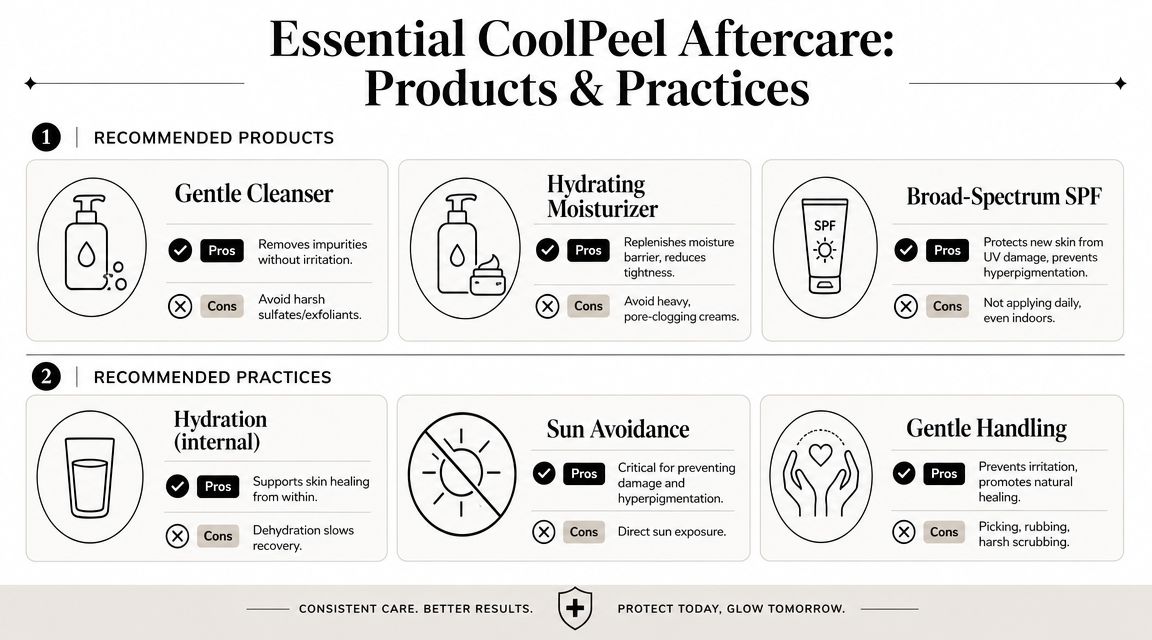
Use a non-foaming cleanser that rinses clean without leaving the skin tight or squeaky. If washing burns, switch to lukewarm water and use your cleanser less often for a day or two. In my practice, that adjustment prevents a lot of unnecessary irritation.
Moisturizer should match the stage of healing and your skin type. In the first few days, a bland cream or ointment usually works best because it cuts down tightness and reduces water loss. Later, once peeling settles and the surface feels less reactive, many patients prefer a lighter barrier-repair cream.
Skin tone and acne tendency matter here. Patients with darker skin tones often do better when we avoid unnecessary irritation early, because excess inflammation can increase the chance of lingering discoloration. Patients who clog easily may need enough moisture to protect the barrier, but not a heavy layer reapplied every hour.
Fragrance, acids, retinoids, and exfoliating scrubs should stay out of the routine until the skin is calm. A product that stings is not helping.
Sun protection is critical for preserving your result and preventing new problems. If sunscreen has not been reintroduced yet because the skin is still too irritated, use shade, a hat, and careful timing outdoors. Once your skin can tolerate it, choose a gentle sunscreen and apply it consistently.
Some patients ask about aloe-based formulas during this stage. That can be reasonable if the product is bland and non-irritating. This ultimate guide for aloe vera sunscreen gives a useful overview of what to look for.
The trade-off is straightforward. A sunscreen that protects well but stings is not a good fit right after treatment. A gentler option that you can wear daily is usually the better choice.
The patients who heal smoothly usually keep the routine boring.
Office advice: Ignore labels like “medical grade” if the formula is too active for healing skin. Choose the product your skin tolerates quietly.
Generic recovery advice usually falls short. Telling patients to “avoid sweat” or “stay out of the sun” is easy. Living that advice while commuting, working, parenting, traveling, or attending meetings is harder.
Practical aftercare guidance often doesn't address those daily scenarios well, even though the early window is when irritation risk is highest, as discussed in these CoolPeel post-care instructions.
Makeup timing depends on how your skin looks and feels, not just on the calendar. In general, lighter protocols may allow makeup once the surface is settled enough to tolerate it, while more intensive resurfacing requires a longer wait. If makeup still stings or catches on flaking skin, it's too soon.
For patients returning to work:
Sweat, friction, and heat all increase irritation in the early phase. Light walking is different from a hard gym session. A cool environment is different from a humid spin class.
Use these decision rules:
If you're rebuilding your sun-protection routine, this ultimate guide for aloe vera sunscreen gives practical context on soothing sun care ingredients. It's helpful once your provider has cleared you to restart sunscreen.
Sun damage is often thought of as a beach problem. After laser resurfacing, it's also a parking lot problem, a driver's seat problem, and a lunchtime errand problem. Short exposures add up when the skin is newly treated.
That's why recovery isn't just about staying indoors. It's about planning your movements.
Redness, warmth, rough texture, and flaking are typical parts of healing. Mild lingering pinkness can also be normal. What deserves attention is anything that looks distinctly off-pattern, especially worsening swelling, pus-like breakouts, spreading irritation, or pain that feels disproportionate rather than gradually improving.
If you're unsure, call. Patients sometimes wait too long because they don't want to overreact. I'd rather answer an early question than see a preventable problem worsen.
If your recovery suddenly shifts instead of gradually settling, that's the moment to check in.
Yes. This matters. A major gap in many recovery guides is advice for deeper skin tones. Patients with darker skin have a higher risk of post-inflammatory hyperpigmentation after laser procedures and often need stricter sun avoidance and pigment-safe aftercare than generic timelines suggest, as noted in this discussion of CoolPeel and pigmentation risk.
For those patients, I'm usually more conservative about sun exposure, heat, and early product reintroduction. If you tan easily or have a history of melasma, say so before treatment and during follow-up.
Not until the skin barrier is clearly calm. If there's still stinging, visible peeling, or persistent reactivity, it's too soon. Restarting too early is one of the fastest ways to create avoidable redness.
Early healing and final improvement aren't the same thing. The peeling may end in the first week, but collagen remodeling continues after that. The skin often looks better before it has finished improving.
If you're considering laser resurfacing or want a treatment plan that matches your skin type, schedule a consultation with Cape Cod Plastic Surgery. Dr. Marc Fater and his team can review your goals, explain whether CoolPeel is the right fit, and give you a clear aftercare plan built around your routine, your skin, and your recovery priorities.
May 23, 2026
Navigate your cool peel recovery day by day with our 2026 expert guide. Discover what to expect, aftercare tips, & when to apply makeup for a smooth healing
May 22, 2026
Discover the best wrinkle filler for your goals in 2026. Compare HA, CaHA, & PLLA fillers for fine lines, folds, and volume. Get expert advice.

May 21, 2026
Considering breast augmentation without lift? Learn if you're a candidate, explore procedural options, and see realistic outcomes with Cape Cod Plastic Surgery.

Cape Cod Plastic Surgery offers expert cosmetic and reconstructive procedures in a safe, accredited setting. Led by Dr. Marc Fater, we combine advanced techniques with personalized care to help you look and feel your best.
Monday: 9:00 AM – 5:00 PM
Tuesday: 9:00 AM – 5:00 PM
Wednesday: 9:00 AM – 5:00 PM
Thursday: 9:00 AM – 5:00 PM
Friday: 9:00 AM – 5:00 PM